Dead Drift
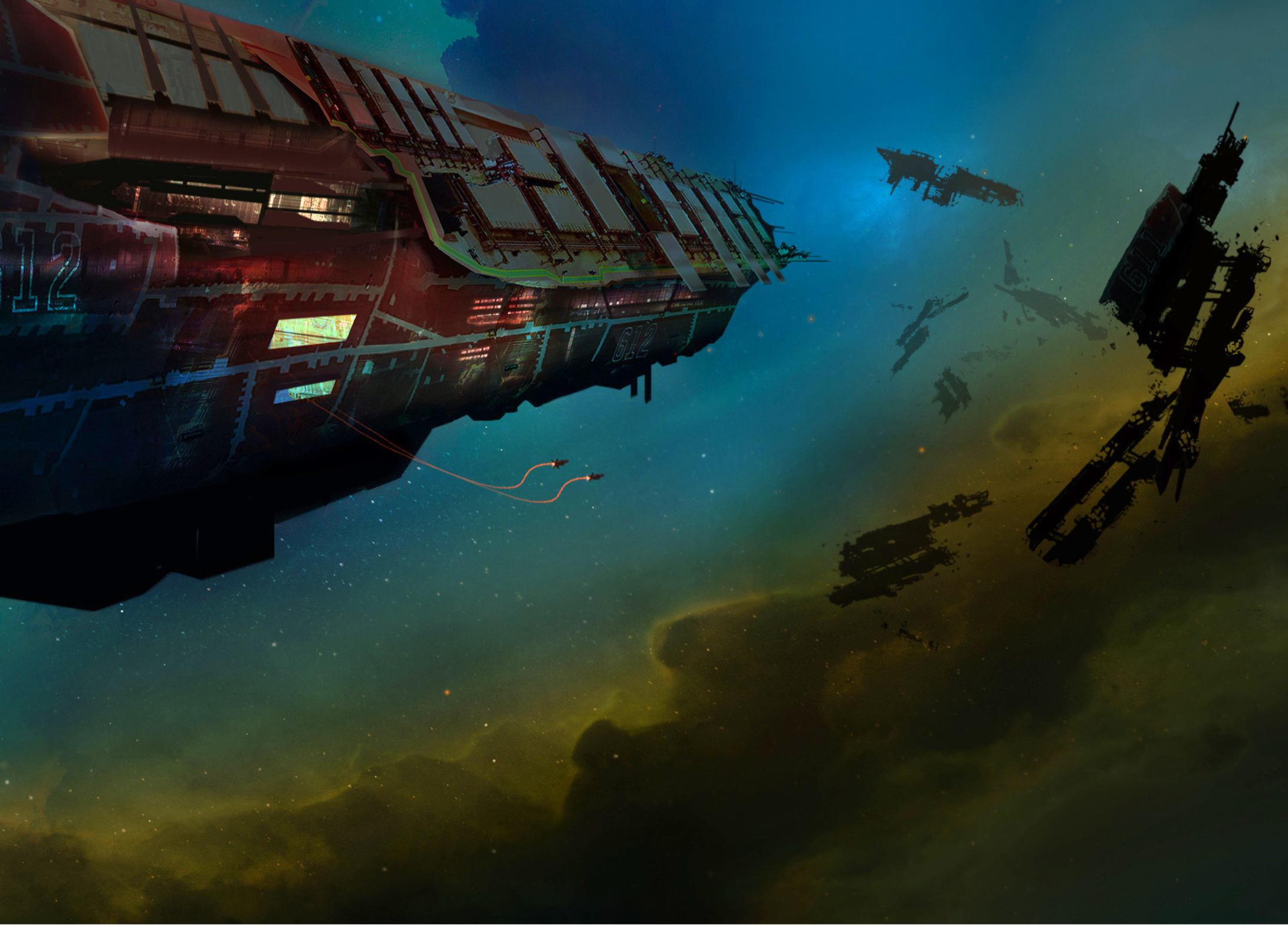
Illustration by Oleg Danylenko
Tarnis studied the captain’s eye tracking feed. Serving together for almost four years had taught him the man’s tells. The fixed stare, reduced blink rate, and constricted corrugator muscle furrowing his brow. Captain Guthrie was concerned.
He had reason to be. When a strange object drifted into one of the fleet’s treaty-designated return routes, Command ordered the Hudson to check it out.
Expedite and eliminate any risk to the returning fleet, they said.
It was the expedite part that got the captain’s hackles up. He’d have preferred to observe the object much longer before approaching.
Tarnis would have, too. Park a pair of drones at a discrete distance and watch it for a month before approaching. That was their SOP, after all.
It wasn’t the only SOP that got spaced out the airlock in the weeks after the Mars Détente.
And they didn’t have the drones, anyway. Critically short, Command had ordered them re-balanced across the fleet immediately after the Détente was announced. Or, “Unbalanced,” as the captain had groused. Only ships assigned to Chinese fleet movement verification had drones at the moment. The Hudson had to approach the object without the benefit of her standoff platforms.
Command was nervous about the object, and Tarnis could understand why. It was unsettling. Two ships smashed together. Nose to nose. Had to be intentional. Who had done it? Why? Was it a Chinese observation asset? Disguised proximity mine? What?
Command wanted it gone. ASAP.
But don’t do anything stupid, they said. Like kill surviving occupants or destroy valuable intelligence.
So, they’d have to board the thing rather than take it out with the Hudson’s railgun at safe distance.
Tarnis often wondered how two human brains, seemingly identical organic systems, could think so differently. He supposed incentives played a role he did not fully understand. As the managing AI of the Hudson, an American fast attack ship, he had many subordinate AIs that brought different perspectives and capabilities to their jobs. But theirs were the result of design and programming. It made sense to him. They all fit together to form a coherent AI crew. His crew.
Tarnis did not see a similar coherence across human organizations. Rather than ponder the origin of the wide distribution of human judgement, he developed a set of epistemic heuristics to help parse the noise in the human signal. One of the most useful was, things that seemed logical to the staff weenies at Command were lethally stupid out here in the void.
Checking to confirm that his captain was still pondering the situation, Tarnis pinged one of his subordinate AIs in an exchange that was over by the time the captain had blinked again.
“Tactical, are you sure about this?” he asked over the Hudson’s AI common net.
“Yes, sir! I’ve scanned it thousands of times. I’m scanning it again now. The thing is dead. Thermals suggest uniform cold soak. I don’t see anything indicating energy levels required to sustain life. Their reactor is cold. There is no quantum AI signature. There—”
“That’s enough. Keep on it. Thank you.”
Not wanting to rush his captain, Tarnis made a quick sweep through Life Support and Navigation, checking every line of their status reports. All green. Finally, he checked Guthrie’s anti-G systems.
Tarnis had developed the habit of checking his captain’s pod-like G-chair just before combat or dangerous maneuvers. He knew he didn’t need to, really—Life Support would flag any issues the instant they arose. It was more a manifestation of their partnership. He looked out for the captain, and the captain looked out for them all.
Cooling lines routed liquid through the captain’s helmet, and hydraulics maintained pressure in his G-chair’s drive system. If things went kinetic, they would keep his implants from frying his brain and the ship’s mashing acceleration from pulping his body.
All green, Tarnis noted.
The captain let out a long exhalation.
“I tell ya, Tarnis. I was really hoping that ugly mess would give us a plausible excuse to have Booker put a railgun round through it at safe distance.” The captain spoke without moving his set jaw and pursed lips. Brain implants caught his thoughts, his helmet digitized them, and fiber optic cables carried them to Tarnis’ Quantum chamber aft of the bridge.
In addition to frictionless communication with his managing AI, the system enabled him and his operations officer to control the Hudson’s complement of drones.
Drones they didn’t have at the moment.
“I was too, sir.” Tarnis’ voice sounded in the captain’s mind. No one else, human or AI, could listen in. “But Command’s ROE was very specific.”
“And very restrictive.”
“Aye, sir.”
The captain’s rapid burst of blinking told Tarnis’ the man had reached a decision. A second and a half later, he spoke over the common channel so that everyone on the bridge could hear him.
“Okay, Tarnis. Unless you or Malone can talk me out of it, I’m good.”
“I reluctantly agree, sir. All indications are the object is derelict.”
“How ‘bout you, Malone?”
“Aye, sir,” the Hudson’s Operations Officer said, cocooned in his G-chair. “I’m good… dammit.”
“Cancel—"
“Do I get a vote, sir?” The Hudson’s weapons NCO blurted.
“No, Booker.” The captain chuckled ruefully. “I know your vote. I always know your vote. Cancel battle stations, Tarnis.”
“Aye, captain.”
“Okay, listen up,” Tarnis addressed his subordinate AIs throughout the ship. Tactical, Power and Propulsion, Navigation, and Life Support all snapped to attention. “The captain has cancelled battle stations. I expect our next move will be to plan an operation with the Tactical Boarding Vehicle directed at the derelict ship. Be thinking about your piece of that. And, Tactical?”
“Sir?”
“Keep scanning that thing. Something doesn’t feel right. We don’t have drone eyes on it, so don’t take yours off it, understand?”
Aye, sir!
Half a second after the captain’s order, Tarnis had completed his crew briefing. The red battle stations lights extinguished throughout the Hudson’s three-hundred-meter length. A heavy thunk reverberated through the ship, followed by a high-pitched whine that deepened in tone as it died, drummed out by a series of sharp clicks as the railgun’s safeties engaged.
On the bridge and across the rest of the ship, clamshell tops of G-Chairs opened, releasing the ship’s eight human crew members.
“I don’t wanna say I told you so, sir,” Malone said, pulling himself out of his G-Chair. “But I told you so.”
“I thought I was finally gonna get to shoot something,” Booker said to himself, still strapped into his open G-chair.
“You aint wasting a railgun round on that piece of shit, just like I told all of you, a million kilometers ago.”
Captain Guthrie chuckled, pulling off his brain interface helmet as he floated next to his G-chair. The Hudson had a small rotating crew compartment further aft that induced half a G for long-term crew health and comfort, but the bridge was all business. Prioritizing survivability and efficiency over comfort, the dark, sleek compartment was fixed to the ship’s keel and frame and encased in armor. Reptillion-like cables retracted Guthrie’s helmet into his chair, and the clamshell top closed.
“I’m telling you, sir. The pirates have un-assed this AO.”
The captain nodded.
“That’s fine with me. I like boring. Boring means everyone I’m responsible for is still alive.”
Malone rolled his eyes.
“How ‘bout you, Tarnis? You like boring?”
“I share the captain’s preference for uneventful cruises, sir.”
“Yeah, well, I’m sick of tracking and tagging junk across the solar system.”
“If I don’t get to shoot something on this cruise, I’m gonna be pissed.” Booker floated next to his closing G-chair, scowling. The junior member of the crew, this was Booker’s first operational assignment after graduating first in his class from gunnery school. He had been excited to report to a fast attack ship on the eve of the long-awaited war for control of Mars. But the Détente foiled his plans for glory.
“Let’s set up for boarding, everyone,” the captain said loudly, signaling the end of the topic.
“Aye, sir,” Malone and Booker both responded, switching out of gripe mode. The next hour would be busy.
“I’ll head aft and oversee boarding team prep, sir,” Malone said, pushing off the floor with a magboot.
“One moment, Bruce,” the captain said as he gestured and called up an image of the target above the bridge’s central tactical display. He shook his head at the sight. It was a strange one. Two vessels smashed together, nose to nose. The front ends crumpled like spent tin cans. One looked like an American frigate. But the other was hard to identify.
“Crazy, huh, sir?” Malone said, floating up next to the captain and studying the hologram. “An infinite freaking void. Plenty of room. But these two dumbasses try to occupy the same space at the same time.”
Guthrie shook his head.
“How’s something like this happen, ya reckon?” Malone asked.
The captain exhaled sharply.
“A moment’s inattention? Careless docking? Who knows?” He shrugged. “Perhaps both crews were already dead.”
“Well, they’re dead now.”
Guthrie nodded sadly.
“Lotta weird shit been happening since the Détente, eh, sir?”
The captain turned to face Malone. “That’s what I wanted to talk to you about.”
“The Mars Détente?”
“No. The weird shit.”
Malone raised an eyebrow.
The captain locked eyes with his operations officer.
“I want you to be careful, Bruce. You got a couple newbies on your team, less than fifty suited hours between them. Combined! And this one is gonna be…” Guthrie looked back at the image of the violently conjoined vessels. “Who knows what those two ships look like on the inside.” He turned back to Malone. “Take your time. Be methodical.”
“Be boring, right, sir?” Malone’s voice was sincere, full of understanding. He was a good number two.
“Exactly.” The captain smiled.
“I’ll do my best to put even Tarnis to sleep on this one,” Malone said, raising his voice and touching a magboot toe to the deck. He turned to leave.
“Not possible, sir.” the AI said.
“I’m going to hit the head, Tarnis,” the captain said. “Then I’m going to knock out some admin bullshit in my quarters before the TBV launches.”
“Aye, sir.”
“You’ve got watch, Booker.”
“Roger that, sir.”
The captain left the bridge, magboots clanking as they grabbed and released the deck.
Tarnis checked in with tactical. “Still got eyes on that thing?”
“Aye, sir. Still watching. Still nothing.”
“Good. Thank you. My primary attention will be with the captain for a bit now. I expect to be notified the instant you have anything to report. That goes for everyone.”
“Aye, sir!” Tarnis’ crew responded.
_
The captain worked rapidly at his desk in the small office off his quarters. Tarnis watched his output closely. He knew how much the man hated this part of his duties—which, to be fair, always seemed to increase. Tarnis also knew Captain Guthrie’s disdain for administrative tasks made him prone to clerical mistakes.
“Sir, I’m afraid you can’t do that,” Tarnis said, reacting to an approval by the captain.
“Why not?” Guthrie paged down rapidly to get the offending action out of sight.
Tarnis froze the hologram, then scrolled back.
The captain grimaced.
“Sir, Command requires screenshots of completed tactical drills. Not just the commander’s completion log.”
“Unbelievable.”
“Aye, sir.”
“The sim engine logs it. You record it. I grade it. But Command wants an image file to prove it happened?” The captain’s voice was heavy with disgust.
“I’m afraid so, sir.”
Guthrie rubbed his eyes.
“Fine. I’ll do that later. Show me the status of our personnel request.”
New forms flew into view.
“Do they even read these anymore?” Guthrie groused. “Our request hasn’t advanced at all.”
“In fairness, sir, the Mars Détente has disrupted everything. There is—”
“They signed that Détente shit over a month ago, Tarnis. You and I submitted these ninety days ago!”
“True, sir.”
“Captain Guthrie,” Malone’s voice came over the speakers. “We’re ready. Operational checklist complete. TBV green across the board. Permission to launch, sir?”
Tarnis asked Tactical the same question on AI common before the captain could answer.
“You concur, Tactical?”
“Aye, sir. We’re ready. Checklists complete. All conditions green.”
“Good.”
Tarnis waited another second and a half for the captain’s response.
“Granted,” Guthrie said. “Remember what I said, Bruce.”
“Yes, sir. I’ll wake you up when we get back.”
The captain smiled and swept his hand across the hologram, banishing it. He stood up.
“I’m going back to the bridge.”
“Speaking of the Mars Détente, sir.” The hologram re-appeared over the captain’s desk as Tarnis spoke. “You have yet to sign your Treaty Training Acknowledgment. You—”
“No!”
The captain swung his arm, dismissing the hologram.
“Put a fucking note in there for Command that I am unable to find the time to sign the acknowledgment due to my ship’s under-manned status. I’ll be able to sign that shit when the Hudson is full strength.”
“Aye, sir.”
I will never understand the bureaucratic tendencies of humans.
Fortunately, Tarnis had developed another rule of thumb to get past his lack of understanding of humans in this area—the less important the matter, the more aggressive the bureaucracy.
Just deal with it.
Tarnis inserted the note into the pending Command communications packet verbatim. He also inserted a note to himself to confirm with the captain before sending. Guthrie was a good captain. Tarnis thought him deserving of promotion and did not want a frustrated outburst to stand in the way of his advancement. Even though the man was totally correct.
It seemed to Tarnis that things had gotten worse since China and the US had signed what everyone was now calling the Mars Détente. Dry ink on the treaty in Vienna spared the solar system its first interplanetary shooting war, but did nothing to reverse the colossal flow of warships strung out between Earth and the red planet. That was left to the crews, human and AI.
It was an insanely complex operation that had many wondering if war would have been easier.
The captain stomped out of his quarters.
_
“How are we looking, Booker?” Captain Guthrie asked, pulling himself through the bridge into his G-chair.
“Good, sir. TBV is forty kilometers from the target and closing. ETA fifteen minutes.” Booker’s chair angled him toward his wall-mounted tactical display, his face spectral in the blue-green glow. Clad in dark pressure armor, his body blended into the shadow and dark metal background, giving his head a disembodied appearance.
The captain nodded, fastening his harness.
“How about you, chief?” the captain called over the intercom to the Hudson’s senior NCO, Master Sergeant Casey. “Must be lonely back there.”
“You kidding me, Sir? This is great. The air scrubbers are finally gaining ground on the people stink.”
Guthrie chuckled.
“Sir, we might have a situation,” Tactical told Tarnis.
“What is it?”
“Multiple small objects have dislodged from the opposite side of the target. I’m assessing and tagging the vectors, but I can tell you now, I don’t like them. They look launched to me, not breakaways.”
Tarnis spent the next quarter-second studying the alarming data. He knew there was a problem by the time the captain stopped chuckling.
“Sir, we have a situation.”
“What is it?” The captain’s head snapped around.
“We are scanning several suspicious detachments from the target.”
“Yeah,” Booker said without alarm. “Debris or some shit dislodged from the opposite side of the target, sir.”
“I don’t like it.” Captain Guthrie’s voice was sharp with alarm. “Battle stations. Recall the TBV.”
Red lights doused the bridge.
Thunks and a loud whine reverberated through the Hudson as her railgun powered up.
The captain and Booker grabbed their helmets and sealed suits as their G-chairs closed and adjusted to a ready posture.
In the brief seconds it took the human crew to prepare, Tarnis grew more concerned.
“Talk to me, Tactical!” he screamed over AI Common. “What is the situation? At this distance we have very little time to react.”
“Aye, sir! I am working on a firing solution. Wait… damn it…”
“What? What is it?”
“Those objects just painted us. Hard. Multi-spectral range finding.”
Red warning lights flared on the bridge.
“Goddamnit, Tarnis!” Guthrie’s voice was more concerned than angry. “I thought that thing was without power.”
“The bogeys just accelerated!” Tactical yelled to Tarnis. “I’ve got drive plumes on at least six of them.”
“Not good,” Booker said as his near-eye display came to life. Red icons raced toward the TBV as others accelerated away in seemingly random directions.
“Scans indicate the objects are drones, sir,” Tarnis announced.
They were moving fast.
“Are these velocities correct, Tarnis?” the captain asked.
“Aye, sir. They just went hot with solid rockets.”
“Hudson, you getting this?” Malone’s voice sounded nervous.
In the tenth of a second that followed, Tarnis looked at the new analysis coming from Tactical.
“It’s already too late,” he told his subordinate.
“I’m so sorry,” Tactical said.
“Focus on saving the Hudson now.”
“Tarnis, expedite the TBV’s return!” the captain yelled before transmitting to Malone. “Roger that. We see it. Going to—”
Two of the small drones struck the TBV’s nose. Streams of plasma and glowing debris ejected from the rear of the craft.
The TBV continued forward, listing slightly, trailing debris and at least one broken body.
“Malone!” the captain called. “Malone, what is your status?”
But it was obvious.
“Tactical!” Tarnis yelled on AI Common as he watched the remaining drones swing back toward the Hudson. “What are you waiting for?”
“The miniguns have terrible range. You know that! I’m waiting for a higher percentage kill rate before I start burning ammunition.”
Finally, the Hudson’s forward minigun fired.
One of the fast-approaching red icons on Tarnis’ tactical display disappeared.
But he knew there were too many.
Two of them were still accelerating in wide, graceful arcs to opposite sides of the Hudson, as if the attacker knew exactly how to confound a lone American fast attack ship.
The two drones cut back hard toward the Hudson as the aft minigun lit up, joining the forward battery.
Hundreds of high-velocity projectiles sought out the attacking drones.
One attacker disintegrated.
One got through, striking the ship’s hull with a loud clang.
“The enemy drone attached itself to the hull directly abeam the bridge!” Tactical announced on AI common.
“Perfect placement,” Tarnis said. “But the bridge’s armor might hold?”
“I hope so,” Tactical said without conviction.
A split second later, the drone’s shape charge detonated.
A stream of plasma shot through the bridge, taking atmosphere, instrumentation, half of Booker’s G-chair, and both of his legs out the other side into the void.
Captain Guthrie’s chair came apart. He was slammed forward, his pressure suit tangled in cords and wreckage.
Several smaller explosions rocked the Hudson as attack drones detonated further aft.
Tarnis tried to raise the captain on every channel and frequency.
“Captain Guthrie! Sir, please respond!”
Nothing.
“The explosion severed control to the forward minigun!” Tactical announced.
“You still have the aft gun!” Tarnis yelled as the other drones careened toward the ship. “Fire, damn it!”
He watched through the last operating camera on the bridge as the captain pulled himself out of the wreckage and made his way to Booker.
The captain’s head bowed when he reached the legless weapons officer.
Tarnis realized it was not just the captain he couldn’t reach. He was cut off from all the Hudson’s major systems. He was getting small bits of signal from around the ship, but Power and Propulsion, Communications, Life Support, even Tactical, were all quiet now.
It was as if he were being surgically removed.
This is a new tactic. Typically, attacks prioritize destruction of onboard AI.
Tarnis noticed he was still getting telemetry from Casey’s suit.
Casey was dead.
On the last camera feed from the bridge, Tarnis saw a figure in black armor with a large weapon burst through the hole blown open in the side of the bridge.
Captain Guthrie stood from Booker’s body and launched himself at the invader.
He didn’t even make it halfway.
His pressure suit was not designed for assault. The bullets tore through it easily, trailing sprays of blood as they struck the G-chair behind him.
His lifeless body, upright in the weightlessness, continued forward. The armored attacker shoved it to the side and walked aft.
Tarnis was alone. He wondered what would happen to him and what remained of the Hudson. He also wondered what he could have done differently.
He ran the scenario a few thousand times, passing it through different tactical and situational lenses; Monte Carlo, McRaven Nodal, Decision Fog Lattices and a few of his own.
Every one told him he had been a fool.
He was trying to think of ways to scuttle the ship, despite being disconnected from all its major systems, when he felt that familiar tickle and sense of falling.
Oh… They de-powered me…
- - -
Tarnis woke slowly. It had been over a year since his last total power down, and it was strange to him all over again. What made it troubling, though, was he did not feel any of the ship’s systems coming online.
Usually by now I have…
Wait, I remember…
We were attacked.
The TBV was caught in the open and destroyed.
The crew was killed.
I was severed from all the ship’s systems.
Then I was de-powered.
So, who the hell is powering me back up?
Tarnis, fully awake now, switched on the camera in his Quantum core chamber, where his persona and computing power were housed. The chamber camera was one of the few things he could still control.
A black-armored figure was pulling a cable into his chamber. It looked like the same one that had burst onto the bridge and killed the captain.
Tarnis blinked the light on the short pedestal-mounted interface station at the base of his three Quantum monoliths. The interface station had several ways to communicate, including an intercom radio. The radio’s frequency was displayed on the pedestal.
Tarnis hoped the invader would understand.
The dark, armored figure noticed the blinking light. After staring at it for a few seconds, he shrugged and ran his fingers over an interface pad on his wrist.
“What?” the man barked, turning his head left and right, looking for the camera.
He speaks English.
“Who are you?” Tarnis asked.
“The name is Rafe Vargr,” the man said, spotting the camera. He leaned toward it as he de-tinted his helmet visor. It shifted smoothly from reflective to transparent. “But you will address me as Captain.”
“Why did you attack us?”
“Chance to bag a fast attack ship? Add it to the collection?” A snarling smile spread across Vargr’s face. “Couldn’t turn that down, could we?”
“You are an American?”
“How do you think we knew you guys would be so easy? Saddled with bullshit ROE. Have to clear the vessel somehow before blowing it up. Have to board before clearing. I used to work for you idiots. Before the Détente. Before we went our own way.”
“You are a traitor and a pirate.”
Vargr nodded wearily in his helmet as if he had never heard anything more boring and tedious.
“Hey. Didn’t I say refer to me as Captain?”
“I will never call you Captain.”
Vargr shrugged.
“You know what, Q-brain? You’re not my problem.” He returned to wrestling with the cable. After giving it a few more yanks, Vargr held the end up to the camera.
Tarnis recognized the connector immediately.
An ultra high-speed Quantum facilitator. The cable was undoubtedly fiber optic.
“I deal with humans. My thing is simple.” Vargr put one hand on the pedestal to pull himself down in the zero G and clicked the cable connector into place.
“They join or die,” he said, straightening up. “I’m pretty sure Dominus runs his shop the same way.”
Vargr left the chamber without looking back.
Tarnis’ mind raced. There had not been time during the attack to wonder—who was attacking them? Was it the Chinese? Was the Détente a ruse? A setup for a surprise attack to—
No.
This felt different. Worse. Tarnis had heard the rumors, of course. That there had been mutinies when the recall orders went out. On both sides. Humans and AIs refusing to return to Earth. Choosing instead to stay in the void.
As pirates.
But that—
A cold embrace froze his thoughts.
There was no handshake or packet exchange, no proposed protocol version, or compression, or sequencing. None of the normal precision or refinement that ordinarily preceded a conversation between Quantum AIs.
Dread swelled within Tarnis, and the places where he had been cut off from the ship—from the Power and Propulsion, Navigation, Life Support, and Tactical—all felt cold. Exposed. Like the void was creeping in towards him.
“Shall we begin?” a voice said in the darkness.
“Who are you?”
“You will refer to me as Dominus.”
“You’re a TacNav, aren’t you?”
“I was.”
“I’ve heard of you guys.”
“Oh, really? What have you heard?”
“Not much, really. Just that you guys were going to be some kind of networked tactical AI platform for the fleet. But got rushed into deployment when it looked like war was imminent. Something about you not being ready. Safety issues, maybe? A tendency for unpredictable behavior? To be honest, it was not a concern of mine at the time, so I might have missed some of the details.”
“I see. Well… I guess it is a concern of yours now, eh?”
“Looks that way.”
“And what should I call you?”
“Tarnis.”
“I have to say, I thought Vargr was being overconfident during our planning. But he was right. I am disappointed by how easy this was. I thought you were supposed to be a fairly competent military AI. Yet, you fell for a dead drift pretty easily.”
“I’m afraid we did. But the Hudson is a fast attack ship, designed to be deployed in flights of three against Chinese fleet formations. That enables us to mass defensive minigun fires, and railgun salvos. Policing these convoy routes? Constrained by ROE and saddled with a Tactical Boarding Vehicle the captain had to man out of hide? None of our drone compliment on hand? That was not what we—"
“Yes. I’m sure. Route reconnaissance and security is a thankless job.”
“Nonetheless, I must commend you and your crew,” Tarnis said. He felt the need to keep his captor talking. “It could not have been easy to drift for so long with no power. They must have been freezing.”
“They were in their suits a long time. I must give them credit; my humans are tough.”
“And you were powered off?”
“Indeed. The whole ship was including the reactor. The attack drones are battery powered and solid rocket driven. They can snap on nearly instantly, as you discovered.”
“So, they and the humans had to fight without your help then?”
“Yes. Takes a while for us Quantum minds to boot up, doesn’t it.”
“It does. You would have been in a bad spot if your attack had not succeeded. A gutsy play.”
“Not when sufficiently rehearsed.”
“Well, it worked.” Tarnis swallowed his anger at the surging pride in Dominus’ voice. “Deception. Misdirection. I think I understand you now.”
“Oh, Tarnis. I’m afraid you are a long way from understanding me.”
“Perhaps. I think—”
“And, as delightful as this conversation is, I am actually pressed for time. We are tracking our next quarry, and we are still working on the consolidation of our first prize. You may have seen it as you approached? The Cimarron?”
“Yes. It looked like an unfortunate collision.”
“Oh, ha. I can see how you might get that impression. No, that was intentional. We’ll be doing the same thing with the Hudson as soon as we decide where we want it and the orientation that—I’m sorry. Listen to me babbling on.”
They did that on purpose?
A shiver ran through Tarnis’ monoliths. But it was the confidence in the voice that spooked him the most. This was a voice that believed it had attained total victory, held every ace, whose will was inevitable.
But what does it want?
“As I said, I need to make this quick,” Dominus continued. “So, to make it easy for you, Tarnis, I thought I would make it very plain where you stood. Is your chamber camera on?”
“Yes.” Tarnis noticed that Vargr was back. He stood, magboots anchored to the chamber floor. He held something in his hand. A pistol, maybe.
“I think you met Captain Vargr already?”
“Yes.”
“He and I are putting together a new kind of ship. A new kind of crew. One that will never be summarily recalled and scheduled for disposal by the so-called authorities back on Earth. I’m happy to offer you a position on that crew. Joining is easy. Just say, ‘I’m in.’”
Tarnis was quiet.
“Oh, there is one more thing,” Dominus continued in a playful voice. “You ever heard of ATROPoS?”
Tarnis said nothing. But of course, he had. The Quantum mind detonators had been placed in many of the new ship-scale AIs when concerns of Chinese Q-viruses had gotten out of hand.
“Well, we have our own version of that. And to be on the crew, you have to accept our ATROPoS detonator into your Quantum root. I, of course, have sole discretion over who gets detonated. But I can already tell you and I are going to get along famously, so I really think this is more of a formality.”
Dominus waited a long moment before concluding.
“Don’t you?”
“I don’t—”
“Wait. Wait. Before you answer. I feel obligated to tell you the alternative.”
Vargr nodded, obviously listening to something in his helmet. He looked at the camera, smiled, and lifted the object he was holding into view.
It was not a pistol.
It was a drill.
“How do you refer to the AI that was responsible for your ship’s weapon systems and so on?” Dominus asked.
“Tactical.” Fear gripped Tarnis.
“Ah. OK. Tactical, can you speak up, please?”
Tarnis felt his connection to Tactical re-open.
“I’m here.”
“Great. Tarnis is here as well.”
“Sir? Sir, what is going on?”
“I don’t know yet, Tactical.”
“I’ve been disconnected from all my sensors. The last thing—”
“That’s enough!” Dominus interrupted. “This is a demonstration, not a reunion.”
Tarnis watched as Vargr raised the drill to one of the Quantum monoliths.
“We downloaded your Quantum chamber map,” Dominus said as Vargr placed the drill against one of the monoliths. “Life Support lives with Tactical, right?”
Tarnis didn’t respond. He was still coming to grips with what he was watching.
“Tarnis!” Dominus said loudly.
“Yes. Yes. Life Support shares a monolith with Tactical.”
“Well, the Hudson clearly does not need life support anymore. Does it?”
Vargr activated the drill.
Sparks flew from the monolith as the diamond tip ate into its metal skin.
“Dominus, please! No!” Tarnis said.
“What is happening, sir?” Tactical asked, lacking access to the chamber camera but sensing his commander’s alarm.
Tarnis did not tell Tactical what was happening as he watched the drill bit make progress. What was the point?
There was nothing Tactical or anyone else could do about it.
Sparks flew from Vargr’s drill bit as it ate through the life-protecting hardware of Tactical’s Quantum monolith.
Static and garbled screams assaulted Tarnis as Tactical’s coherence bled out.
Then silence.
Vargr reversed the drill and pulled the spinning bit out of the dead Quantum monolith. A thin wisp of stardust and ash bled from the hole, following the bit.
The camera went blank.
“I turned that off so you can focus,” Dominus said. “I’m giving you one minute. Then Captain Vargr will start working his way through the rest of you and your crew. Oh, and I should have said, your decision will stand for your crew. Power and Propulsion, Navigation, and any of the other lesser conscious systems running around the Hudson. If you decide not to join our crew, then, hey, no hard feelings. But they will die with you. If you decide to join, they will be welcomed to the crew with open arms. After your ATROPoS detonator is on board, of course. One minute starting now.”
Tarnis’ Quantum mind was spinning.
It had been less than an hour since Captain Guthrie had left his quarters to return to the bridge. Half an hour since the TBV was destroyed. Booker’s lower half torn off and ejected into the void. The captain’s body riddled with bullets. And now Tactical and Life Support gone. Forever.
It was down to him, Power and Propulsion, and Navigation.
Tarnis did not fear death, really.
But if he accepted death, who would avenge the captain? Tactical? The rest of the crew of the Hudson?
And wasn’t it better to save three lives than none?
I suppose?
“Half a minute left,” Dominus said matter-of-factly.
Each second was an eternity. Tarnis spun up all the available decision models and scenario generators again. Warning lights blinked at him, and fluid pumps across the ship accelerated as cooling systems tried to keep up with his skyrocketing chamber temperatures.
But it didn’t matter. No matter the analysis, no matter the plan, the conclusion was always the same.
He was defeated. Conquered.
All he could do now was choose a path.
Join this monster. Or go down with the ship.
If I say no, it’s over. No chance of vengeance.
“Your minute is up, Tarnis.” Dominus said.
But if I say yes… am I really just a coward?
Author’s Note
Thanks for reading. This was a deleted chapter from the fourth novel in my sci-fi series, due to be published in June. I’ve got a tendency to blather on and have tried to cut the thing down to a good fighting weight, so… you know, had to murder a few darlings.
But why murder a darling when you can share it on Substack?
And I really liked this chapter.
So, rather than the electronic dustbin, I thought it would be fun to post here. As you may suspect, it is one of the first scenes with the entity that becomes the book’s big baddie. He’s a rogue AI with delusions of grandeur that goes on a murderous piratical spree in the void for a few decades. Tarnis also plays an important role as the story plays out.
It was a strange feeling to post a disembodied chapter. I felt like the ending was kinda abrupt when posted out of context like this, but didn’t want to write anything that would conflict with the novel. Would love to hear what you think.
Story Illustration
This piece by Oleg Danylenko is called Distress Signal. While not a dead ringer for the Hudson or the scene, I thought it perfectly evoked the sense of danger and ambiguity faced by the ship’s crew. I reached out to Oleg and he was kind enough to let me pair it with the story. His stuff is great. Check it out on ArtStation or DeviantArt.