Spies waste no words
You ever finally read a book that folks have been recommending to you for decades? Was it good?
I just finished The Spy Who Came In From The Cold by John le Carré. It’s been in my TBR pile since I was a brand-new Army Lieutenant stationed in Germany as the Cold War came to an anticlimactic end. Even worse, having written a contemporary military espionage novel, I am often asked what my favorite spy novel is. Folks are disappointed when I look at them blank-faced and admit I don’t really have one. I wrote mine out of respect for a good friend’s service in the GWOT, not the pull of genre.
Well, I have a favorite now.
Here is the setup: After losing his last agent in Berlin, MI6 officer Alec Leamas is summoned back to England to ride a desk or accept forced retirement. When he is offered a chance at revenge against the brutally efficient East German intelligence officer who rolled up his spy network in Berlin, he takes it. Posing as an alcoholic, bitter ex-agent with an axe to grind, he dangles himself as bait. When his target rises to take it, it sets in motion a plan that Leamas can’t quite discern. But whose plan?
The book’s narrative voice, setting, and plot combine to create a dark, heavy atmosphere that settles on the reader like a dense, anxiety-inducing, European fog.
Written in third person, there was something about the voice that intrigued me. But when I sat down to articulate it in my reading notes, I found it difficult to describe. Unobtrusive? Efficient? Suggestive? If you’ve read any of my previous essays, you’ll know I gravitate towards lean narration that saves its punches until they really count. Some of that was at work here. But there was something else, too. Then it hit me—this is the voice of a spy. Not memorable unless he wants it to be.
The author was, in fact, a spy. David Cornwell wrote the book, and several others you’ve likely heard of, while serving in Britain’s MI6. The pen name John le Carré was to protect his true identity. His career was ended by the infamous double agent Kim Philby, who betrayed so many agents to the Russians in 1964. So, yeah… the voice clocks.
The Cold War setting is dark and intriguing. It’s strange now, like many aspects of that time, to think of a divided Germany and the encircled bastion of freedom, deep behind the Iron Curtain, that was West Berlin. And it does seem cliché to note that things seemed so much simpler then. The good and bad guys so much easier to parse. Weren’t they?
Personal confession—call me nostalgic, but I’m a sucker for all that stuff. I spent three years in Germany as an Army officer and then another back there decades later as a civilian expat. I walked a long stretch of the Berlin Wall on leave in the summer of 1989. Seems surreal now. Stone-faced guards peering from armored towers over the stretches of no man’s land on the eastern side. Graffiti and derelict buildings on the west. Less than six months later the wall came down, and a year later Germany was one country again. (The End of History, right? Ha.)
But what is nostalgic to us now was new and terrifying when the book first came out. The Wall went up in 1961. The book in 1963.
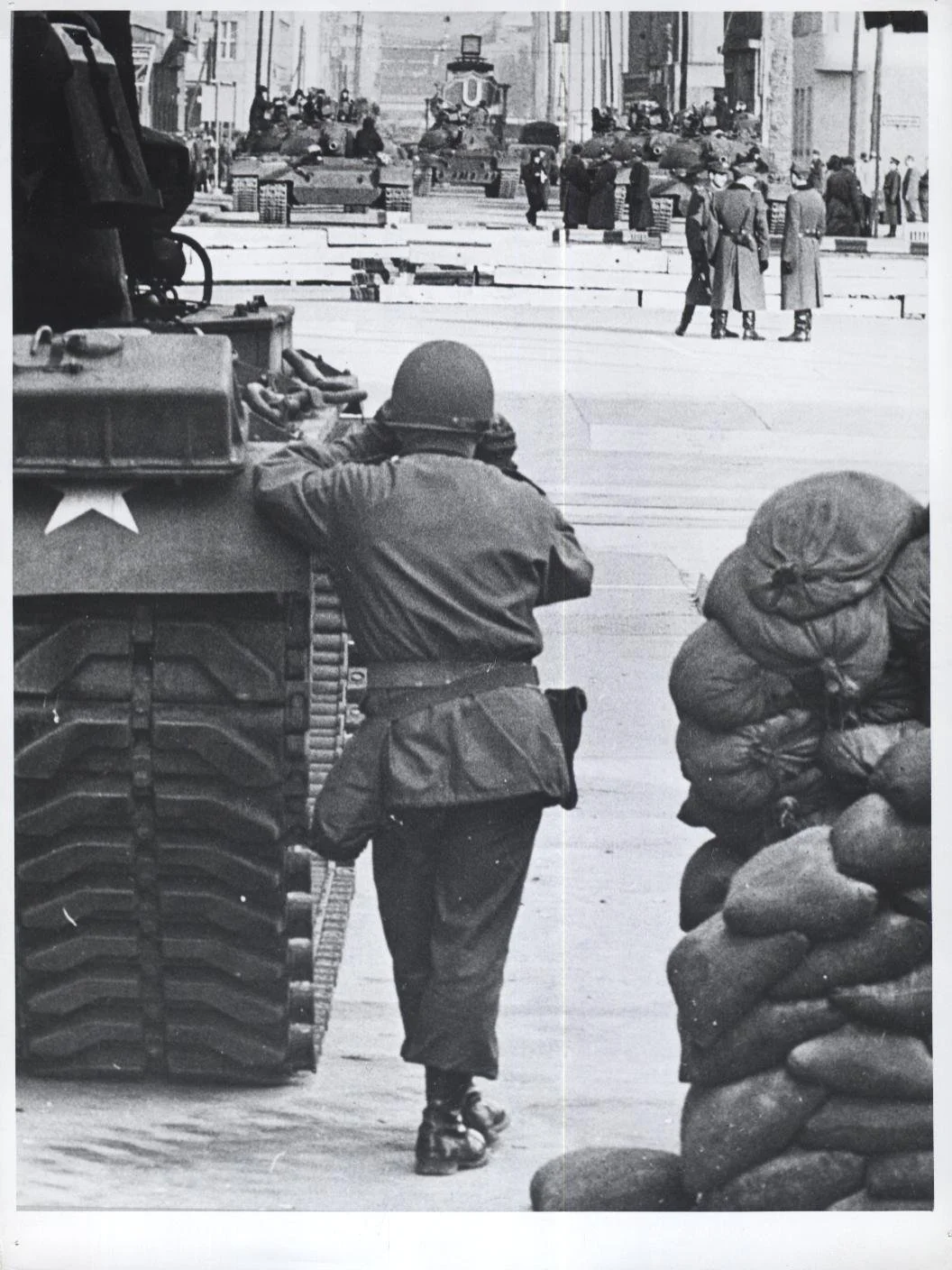
28 October 1961 - An American officer monitors the movements of Soviet tanks during the confrontation at Checkpoint Charlie. Photo from CIA flicker account.
I’m not saying all that features vividly in the novel. Far from it. In fact, most of the book is really just a few people in plain rooms. Talking. It’s pretty mundane. But le Carré makes sure the reader is aware of the global and institutional forces at work, looming just out of view. And the story is bookended by its inciting and final scenes that play out under the spotlighted firing zones of the Berlin Wall at night.
It was so effective I have to wonder how the book lands with a younger reader. Perhaps one who came of age after 9/11. Do the Berlin scene bookends and understated shadows of world events cast the same legit, propulsive spell? If you don’t have the same connections to those times, is the sense that big things are pulling strings just out of frame as strong?
Finally, the plot. Look, bottom line, it shouldn’t work so well. It’s a bag of tropes. The burned-out, cynical spy. The innocent, unwitting sacrificial pawn. The puppet-master you just know is screwing Leamas. But it does work. The pieces fit together like the teeth of a ratchet, so that as the story progresses, each increase in tension is trapped and builds, with nowhere to go.
Just like Leamas.
It’s not a spoiler to say that the ending is tough. Not in an Old Yeller or Where the Red Fern Grows gut you kind of way. More like a, Shit…Ain’t that just how the world is, kind of way. Institutional indifference to personal loyalties, duty versus personal obligation, honor or survival, collateral damage—all of it comes due. It’s satisfying too. And, if you squint your eyes and cock your head as you stare at it… hopeful? Leamas meets his karma with an action and measure of honor that surprises. Or was it resignation? I don’t know. But a fitting end.
The last thing that must be mentioned is the book’s length. It’s short. About 64K words. Around 230 pages, depending on layout. But man, it packs a wallop. It’s like the depleted uranium round of books—massive kinetic energy in a small package. As a writer, I took it as a lesson. Truthfully, I struggle with length. My spy novel is 205K words. More than three times as long as Spy and nowhere near the reader impact. I like to think the length is earned. And let’s be honest, a reader can live in a well-written book for a while. (Not claiming to write well. Saying that’s the goal). But I readily concede, le Carré’s punch lands much harder.
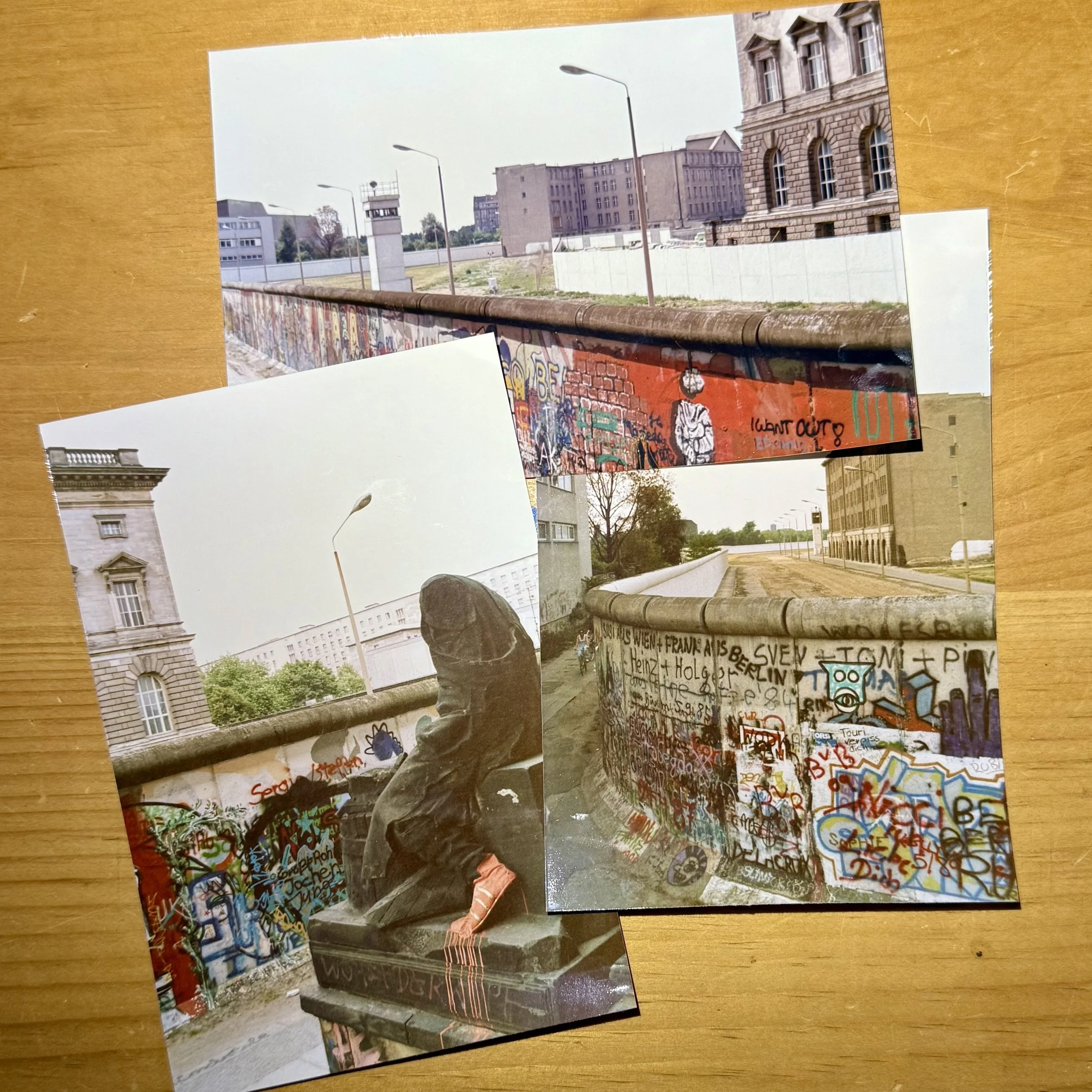
Photos of the Berlin Wall in 1989 taken by the author.